

Transparency Matters At Lissmy.com, I only recommend products I have thoroughly researched and believe in. Affiliate links in this post mean I may earn a small commission if you make a purchase, at no extra cost to you. As an Amazon Associate, I earn from qualifying purchases. This helps keep this site running and the content free thank you for your support!
Table of Contents
Have you been taking care of your skin for years, trying every expensive product, yet still not getting the results you want?
If you feel like there is an unsolvable puzzle, the secret might be hiding in your gut, not in your bathroom cabinet.
1. Introduction: Beyond the Surface
How many times have you felt frustrated because your skin does not respond to topical products, no matter how high their quality? The truth is that your skin is a mirror reflecting what is happening inside your body.
The connection between your digestive system and your skin known as the gut-skin axis is proof that the root of your problem may be much deeper than the surface.
In this comprehensive guide, we’ll help you become your own health detective by recognizing the silent signals your gut is sending you, understanding how these signals translate into annoying skin issues, and knowing when its time to start supporting your digestive health to restore your natural glow.

For a complete overview of how your gut affects your skin after 35, read our comprehensive guide: The Complete Guide to Gut-Skin Health After 35.
2. The Communication Highway: How Your Gut Talks to Your Skin
Before we dive into the symptoms, it is crucial to understand how this communication works.
• The Immune System: About 70% of your immune cells reside in your gut.
When your intestinal bacteria are out of balance, your immune system sends inflammatory signals that can travel straight to your skin.
• Increased Intestinal Permeability (Leaky Gut): When the gut lining is damaged, large particles and toxins leak into your bloodstream, triggering a systemic inflammatory response.
This internal inflammation often shows up on your skin as breakouts, redness, or dryness.
Understanding this mechanism explains why hidden digestive imbalances are often the root cause of many persistent dermatological concerns.
To learn more about how medications affect this axis, check out our previous guide:
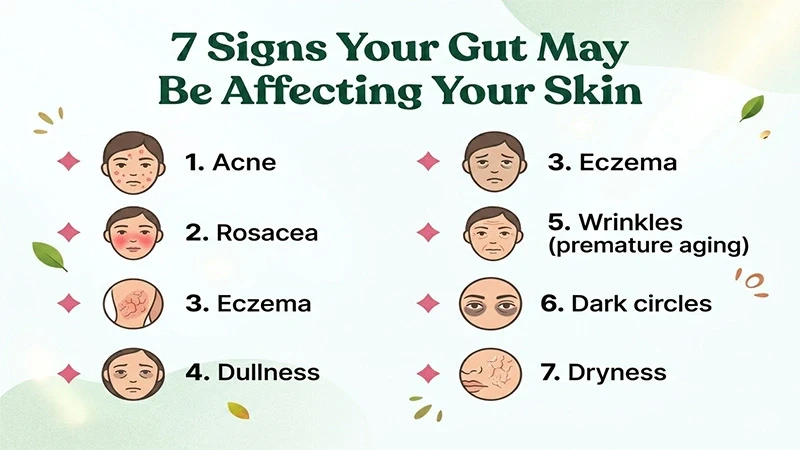
5 Common Medications That Disrupt Your Gut-Skin Axis →3. The Main List: 7 Silent Signs Your Complexion Problems Are Coming From Your Digestive Health
If you are experiencing any of these signs alongside your skin concerns, it is time to start treating the problem from the inside out.
Sign 1: Persistent Bloating & Indigestion
Feeling overly full or gassy after meals-even small ones is a clear sign of gut dysbiosis (bacterial imbalance) or poor digestion.
This internal inflammation will inevitably show up on your skin.
Sign 2: Symptoms That Flare After Eating
If you notice breakouts or skin sensitivity within 24–48 hours of eating certain foods (especially dairy, sugar, or gluten), you are seeing a direct sign of an undiagnosed food sensitivity attacking your immune system and manifesting on your skin.
Sign 3: Chronic Fatigue & Brain Fog
Gut health is the foundation of energy production. An unhealthy gut leads to poor absorption of essential vitamins (like B12 and iron) and produces toxins that cause brain fog.
If you are constantly tired and your mirror reflects a dull complexion, there is a strong link.
Sign 4: Intense Sugar Cravings
Harmful gut bacteria feed on sugar. When they overgrow, they send signals to your brain to crave more sugar.
This leads to more inflammation and a process called glycation, which destroys collagen, accelerates skin aging, and worsens acne.
Sign 5: Autoimmune Skin Conditions
There is a strong connection between gut dysfunction and skin conditions like psoriasis and eczema (atopic dermatitis).
Treating these conditions is extremely difficult if you only focus on the surface without addressing the root inflammation coming from the gut.
Sign 6: Constant Anxiety & Stress
The gut-brain-skin axis is a real triangle. Anxiety worsens gut symptoms, which in turn increases cortisol (stress hormone) production.
Cortisol activates collagenase (an enzyme that breaks down collagen), reduces skin elasticity, and triggers hormonal acne.

Sign 7: Poor or No Response to Topical Skincare
If you’re using more than 3 targeted skincare products and your acne isn’t clearing up or your skin isn’t glowing, this is the biggest proof that the root cause requires internal support (like probiotics), not just another cream.
4. Deep Analysis: Comparison Table of Symptoms
To make it easier for you, here is a table distinguishing between a “cosmetic flaw” and a “serious health symptom.”
| Skin Concern | If the cause is Topical / Cosmetic | If the cause is Gut-Related |
|---|---|---|
| Acne | Blackheads & whiteheads; responds to salicylic acid. | Deep, cystic acne along the jawline and chin; worsens with stress and sugary foods. |
| Dryness & Dullness | Improves with hyaluronic acid and ceramides. | Persistent dryness and flaking around the mouth and nose; doesn’t improve with rich moisturizers. |
| Rosacea | Intermittent redness triggered by heat or spicy food. | Persistent redness accompanied by bloating and gluten sensitivity. |
| Dark Circles | Genetic or due to lack of sleep. | Accompanied by under-eye puffiness, chronic fatigue, and iron malabsorption. |
5. Practical Solutions: What to Do to Support Both Your Gut and Your Skin
If you recognize yourself in the right column above, do not worry.
Here is an action plan to start your healing journey:
1. Try an Elimination Diet: Remove gluten and dairy for 3 weeks and observe the difference in your skin.
2. Add a High-Quality Probiotic: This is your secret weapon to rebuild your army of good bacteria.
Read our comprehensive guide on how to choose the right one here:
How to Choose a Probiotic for Your Skin After 35 (A Buyer’s Guide) →3. Focus on Prebiotics: Eat foods that feed your good bacteria garlic, onion, green bananas, and asparagus.
4. Seek Medical Help: If symptoms are severe, talk to a functional medicine doctor about a comprehensive stool analysis.
6. Frequently Asked Questions (FAQ)
Q: How long does it take to see skin improvement after starting gut treatment?
A: Your skin typically takes 4 to 6 weeks to reflect internal changes.
This is the average skin, cell turnover cycle.
Q: Is taking probiotics alone enough to heal my skin if I have leaky gut?
A: Probiotics are essential but not enough on their own.
You will also need gut-healing nutrients like L-glutamine and need to avoid inflammatory trigger foods.
Q: Is there a medical test to prove my skin issue is coming from my gut?
A: Yes. A Zonulin test (blood or stool) measures markers of intestinal permeability.
A Comprehensive Stool Analysis can identify bacterial, fungal, or parasitic infections driving skin inflammation.

7. Final Thoughts: Invest in the Roots of Beauty
Long-lasting, resilient skincare does not come from an expensive bottle it comes from the food you eat and the health of your gut.
If you are struggling with mysterious symptoms or stubborn, treatment-resistant skin look at the silent signals listed above.
There is a high chance your gut is trying to tell you something important. Listen to it, and your skin will naturally start to glow.
For more on specific foods that boost radiance, browse our guide:
The Skin-Gut Axis Diet: 7 Essential Foods for a Radiant Glow After 35 → Another of our articles is also known as Glowing Skin from Within →Medically Reviewed Disclaimer
This article is for informational purposes only and does not constitute medical advice. It is not a substitute for professional medical advice, diagnosis, or treatment. Always seek the advice of your physician or another qualified health provider with any questions you may have regarding a medical condition or before starting, stopping, or altering any medication or supplement regimen.
References & Further Reading
1. The gut-skin axis in health and disease: Dermato-Endocrinology. Read the study
2. Systemic inflammation and acne: Journal of Clinical Medicine. Explore the research
3. Glycation and collagen destruction: International Journal of Molecular Sciences. Read the study
4. Gut-brain-skin axis in acne: Advances in Dermatology and Allergology. Explore the research
5. Zonulin as a marker of intestinal permeability: Nutrients Journal. Read the study
6. Harvard Health: The gut-skin connection. Visit Harvard Health